
Running a Sex Offender Check in Schleicher County
The Texas Public Sex Offender Registry is the primary public channel for Schleicher County. The Texas Department of Public Safety Crime Records Division manages it under Code of Criminal Procedure Chapter 62. The Schleicher County Sheriff's page points to that state service rather than hosting a local list, map, or downloadable roster. Basic public registry searches are free and do not consume the paid credits used by the separate DPS criminal-history name product.
Begin with the smallest set of reliable facts. A correct spelling may lead to a name result, while an Eldorado street address, ZIP code, or county filter can show a place-based set. Results reflect registration data, not a complete account of every criminal case. Check the reporting agency, risk label, offense details, and current status on the full profile. When a fact seems stale, the listed registration authority is the best confirmation point.
Schleicher County DPS Registry Interface
The official DPS registry search screen shows the state system before any private person is selected. It separates identity searches from location, county, school-affiliation, high-risk, and map tools.
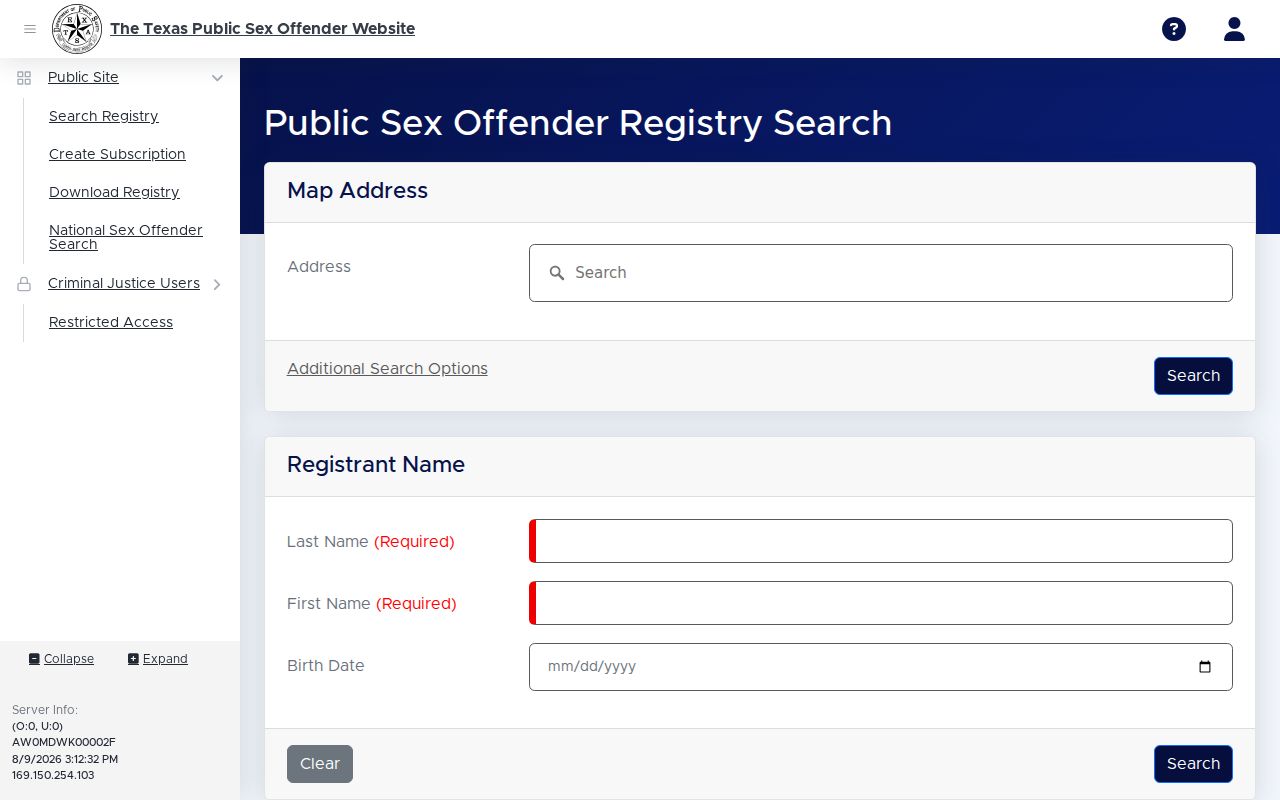
That range of controls helps a Schleicher County searcher test more than one route. A name query may miss an alias or spelling variation. An address search depends on correct geocoding, while a county filter follows the reporting geography in the record. None creates a safety boundary around the plotted point.
Users must accept the portal's conditions and lawful-use warning. Save enough detail to identify the profile later, then confirm any concern with the authority named on that record. The database can have reporting lag or errors because its facts come from registrants and government offices.
Searching the Texas Public Sex Offender Registry
DPS offers several ways to search Schleicher County registry records. Choose the mode that matches what is known. Do not force a broad name result to fit the person or place in question.
- Open the official registry and read and accept its conditions of use.
- Choose name, address or map, county, institution of higher education, or high-risk search.
- Enter the most exact known identifiers, then review the result list for aliases and location details.
- Open the full profile and compare the photo, description, offense, reporting agency, risk level, and status.
| Search mode or control | Function | Required | Important limit |
|---|---|---|---|
| Name | Searches registrant identity | Mode dependent | Spelling and aliases matter |
| Address or map | Finds registrations near a place | An address for this mode | Geocoding and radius are not safety lines |
| County | Filters reporting geography | County selection | Confirm the registration authority |
| Institution of Higher Education | Searches statutory school affiliation | Mode dependent | Not a general county query |
| High Risk | Filters assessed risk | Mode dependent | Risk level is not duration |
| Subscription | Saves areas for public alerts | CRD public account | Define the saved geography with care |
Public Sex Offender Subscriptions and registry downloads use a Crime Records Division public account. The alert channel can help with later changes, but it does not replace a fresh profile review or direct confirmation.
Schleicher County Registration Office Route
Texas assigns registration work by residence. A person living in a municipality generally reports to the police chief or local authority, while a person in an unincorporated area reports to the sheriff. Official Eldorado materials do not establish a stand-alone police records or registry office. That makes a phone confirmation important before anyone assumes where an appointment occurs.
Confirm the Current Registrar
Schleicher County Sheriff
4 S. Divide Street
Eldorado, TX 76936
325-853-2737
City Hall
203 N. Main Street
Eldorado, TX 76936
325-853-2691
Call first and ask which authority handles the address, where registration appointments occur, and what schedule applies. The Schleicher County directory can confirm current county office pages. A public-record counter should not be treated as a compliance office without confirmation. Suspected noncompliance can be reported to the authority listed on the profile or to the sheriff. Emergency threats belong with 911.
Note: Schleicher County publishes no separate local registry list, so DPS remains the public search while local offices confirm registration logistics.
What a Registry Profile Shows
Chapter 62 authorizes Texas agencies to collect a wide set of identifying and case facts. The public view releases a narrower set for awareness. It can show enough detail to distinguish two similar names without revealing victim identity or protected personal identifiers.
| Name & Aliases | The registrant's public identity and reported alternate names. |
|---|---|
| Photo & Description | A photograph and physical traits such as sex, race, height, weight, eye color, and hair color. |
| Registered Address | The public residence or geographic description that the authority reports. |
| Offense & Outcome | The reportable offense, conviction information, punishment, and victim-age category where public. |
| Risk Information | Texas risk level and the reporting or registration authority. |
| Status | Compliance, supervision, release, or other registry status made public by DPS. |
Texas may collect fingerprints, shoe size, driver-license facts, phone numbers, online identifiers, vehicle details, and higher-education status. The public profile does not release every collected field. Social Security numbers, driver-license numbers, phone numbers, online identifiers, victim-identifying data, protected DPS information, and juvenile data ordered nonpublic remain excluded under Article 62.005.
Schleicher County Registry Risk and Duration
A common error is to read Texas risk level 1, 2, or 3 as a ten-year, longer-term, or lifetime tier. Texas does not map those labels directly to federal SORNA Tier I, II, and III duration rules. Risk is an assessment used chiefly for notification. Registration length turns on the offense and circumstances listed in Article 62.101.
- Risk level
- An assessed notification category: low, moderate, or high.
- Duration
- The statutory period tied to the reportable offense and case circumstances.
- Verification
- The required schedule for confirming registration information with the responsible authority.
Listed serious or repeat reportable offenses generally bring lifetime registration. Other qualifying cases generally run for ten years after the release, discharge, or dismissal point that the statute directs. Some transferred juvenile matters have a distinct ten-year rule. The current statute and the registration authority control an individual question.
Registration Requirements and Levels in Texas
The Texas Sex Offender Registration Program explains state duties and links to current resources. Its official program material helps separate risk labels, registration duration, and verification frequency.
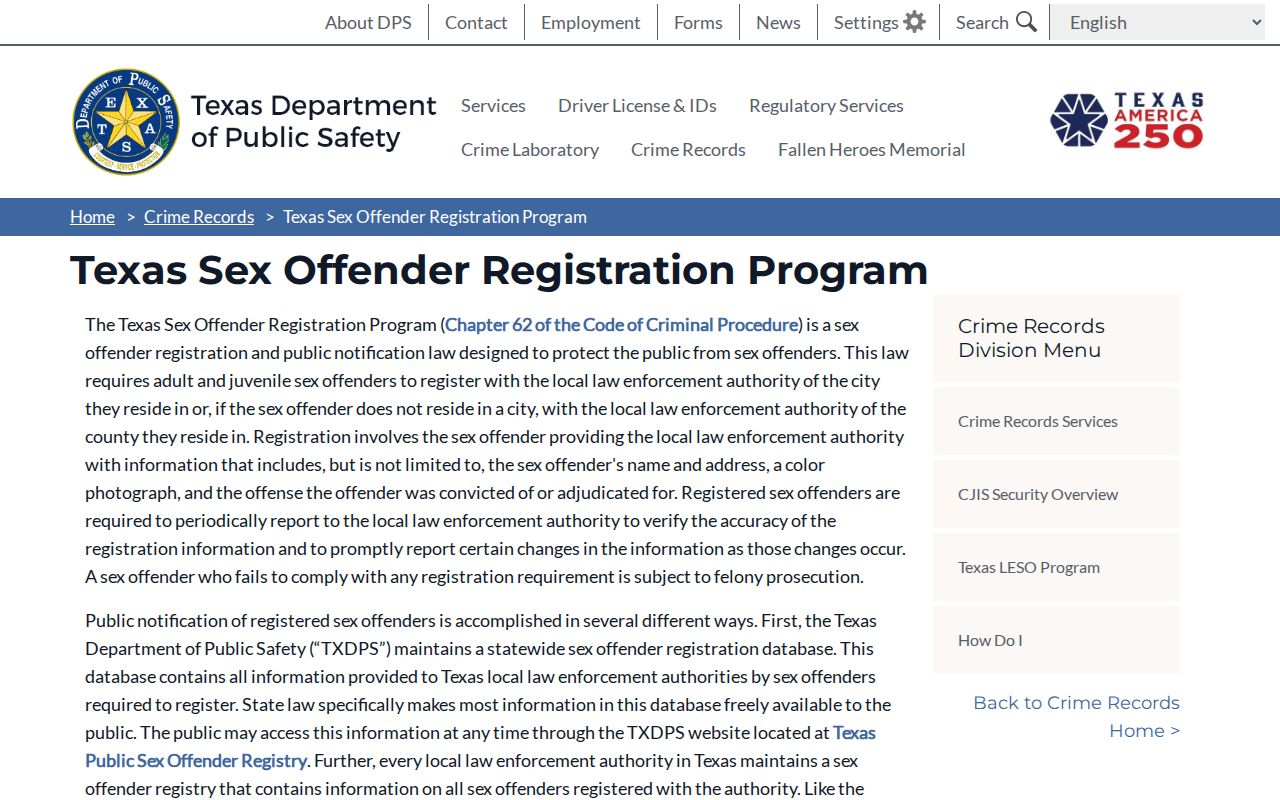
The program page supplies the statewide frame, while a person's profile and local authority supply case-specific facts. Ordinary verification is annual. Two or more reportable convictions or adjudications can require a 90-day schedule, and civil commitment can require checks every 30 days.
| Texas concept | Duration | Verification or notice |
|---|---|---|
| Risk level 1 | Offense based, not set by the label | Low assessed risk; ordinary schedule may be annual |
| Risk level 2 | Offense based, not set by the label | Moderate assessed risk |
| Risk level 3 | Offense based, not set by the label | High assessed risk; added notification provisions |
| Lifetime category | Listed offenses or repeat circumstances | Schedule may tighten based on case status |
| Ten-year category | Specified reportable or juvenile circumstances | Measured from the point named by statute |
For a level-3 registrant, Chapter 62 provides for written DPS notice in English and Spanish within one mile in an unsubdivided area or three blocks in a subdivided area. A local authority may also use a newspaper, meeting, posting, printed notice, or specialized website.
Schleicher County Registry Residency Rules
Texas does not impose one blanket school or park distance that applies in the same way to every registrant. Local Government Code Section 341.906 lets a general-law municipality adopt a child-safety-zone ordinance within statutory limits and exceptions. No Eldorado ordinance was found in the official sources reviewed.
That absence matters. A map radius should not be mistaken for a legal residency line, and a rule from another Texas city should not be applied to Eldorado. Ask City Hall about any current city ordinance and ask the registration authority about case-specific duties. The registry profile, court order, supervision terms, and local ordinance can answer different questions.
Lawful Use and Community Notification
Registry information supports personal, family, and neighborhood safety decisions. It does not prove that a person is committing a new offense, and it should not become a basis for confrontation. Address and status information can lag. Confirm an apparent error with the profile's reporting authority, especially before sharing it with others.
Use registry data lawfully: Misusing registry information to threaten, harass, intimidate, discriminate unlawfully, or commit another crime can itself violate Texas law. Code of Criminal Procedure Chapter 62 governs the registry and its public notice.
For risk-level-3 community notice, the statute defines the area and lets local authorities choose added methods. A public subscription can provide alerts for saved areas. Neither form of notice replaces direct emergency reporting or careful review of the current profile.
Schleicher County Registry and NSOPW
The U.S. Department of Justice National Sex Offender Public Website adds a cross-state search layer. It is useful when a person has moved, an address sits outside Texas, or the correct reporting jurisdiction is not clear.
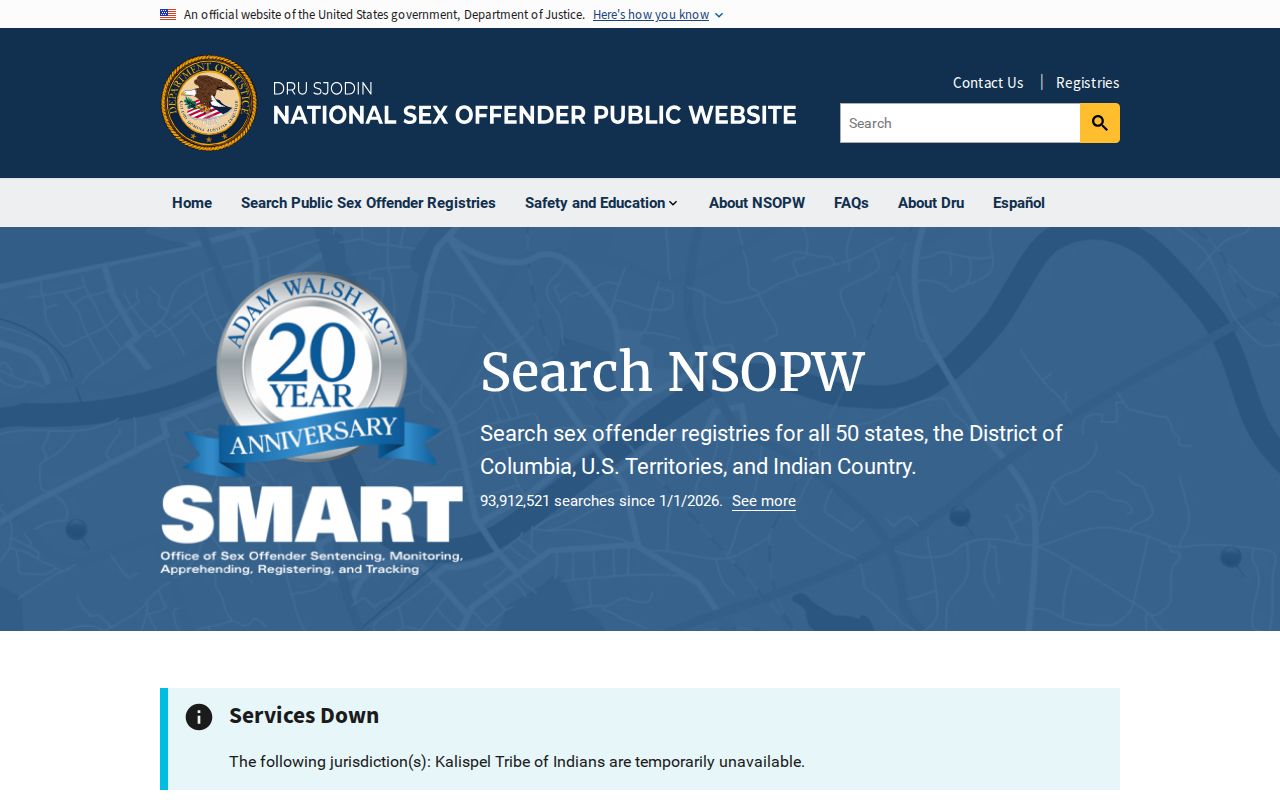
NSOPW queries participating jurisdictions, while the DPS registry is the direct Texas source for a Schleicher County result. Search both when geography is uncertain. Then return to the source jurisdiction's profile and conditions because national aggregation does not erase local definitions, update cycles, or restrictions.
A missing NSOPW result does not settle identity or status by itself. Try name variants and the Texas location modes, and report a stale Schleicher or Eldorado record to its listed registration authority. This layered method keeps the search tied to official sources.